“Доки Україна зберігає свою національну єдність,
доки її народ продовжує думати про себе як про
українців і домагається незалежності, доти вона
становить серйозну загрозу для самої суті совєтизму.”
Рафаель Лемкін [1]
Незабаром настане день пам`яті жертв Голодомору 1932-1933 років. Ця тема сьогодні займає одне з найпомітніших місць серед наукових публікацій, а також публікацій у ЗМІ тому що, чи не вперше, за всю новітню історію української державності вона опинилася в центрі постійної уваги не тільки української спільноти, але й усього світу. Не останню роль відіграє і той фактор, що українське суспільство, продовжує активно осмислювати трагічні і повчальні сторінки історії українського народу, незважаючи на більш ніж “прохолодне” ставлення до цієї теми нинішьої влади… Для мільйонів українців дослідження Голодомору-геноциду продовжує бути фактором самоідентифікації, зв`язуючим духовним містком між живими і померлими.
Разом з тим, в окремих дослідженнях цієї теми іноді бракує документальних першоджерел, в першу чергу, архівних. І якщо вже опубліковані збірники документів, які висвітлюють геноцид українського народу в „узагальненому” вимірі, тобто на рівні розпорядчих документів, задокументованих спогадів, тощо, то майже немає (і не могло бути) персональних даних про загиблих голодною смертю в часи будівництва „світлого майбутнього”, хоча саме на створенні такого списку постійно наголошується у всіх загальноукраїнських та місцевих програмах досліджень та пам`ятних заходах.
Саме тому, без наявності документальної бази, практично була відсутня історіографія з даної проблеми. Виняток становить книга Олекси Калиника „Що несе з собою комунізм?”[2] та зовсім невелика кількість видань, які з`явилися впродовж кількох останніх років [3].
Цьому є пояснення, адже до останнього часу книги Реєстрації Актів Цивільного Стану (РАЦС) за 1932 – 1933 роки, як основне документальне джерело з даної проблематики, знаходились на зберіганні в підрозділах Міністерства юстиції України. Нині вони передані на постійне зберігання до держархівів областей. Всього до Державного архіву Сумської області (далі – ДАСО) восени 2007 року було передано 715 одиниць зберігання. Враховуючи те, що приблизно третина їх містить акти про смерть громадян в період Голодомору, спробуймо провести аналіз діагнозів про смерть в 1932-1933 роках та розглянути перспективи для складання персональних даних жертв геноциду українського народу на прикладі окремих районів Сумської області.
Аналіз діагнозів про смерть наближає дослідників Голодомору 1932-1933 років до вивчення не тільки кількісних характеристик, але й дає можливість поглянути на проблему під різними кутами зору. Наприклад, якщо переглянути всі 182 (виявлені на даний час) діагнози, то можна побачити розмір фальсифікації історії Голодомору уже в час його проведення. Адже такі пояснення причин смерті десятків і сотень людей в одній книзі, як „невідомо”, „від хвороби”, а то й відсутністю записаної причини вказують на те, що комуністична влада навмисно ховала правду, отже, повністю усвідомлювала злочинність своїх дій. Тому намагання сучасних апологетів більшовизму списати мільйонні людські жертви на засуху, „шкідництво куркульських елементів”, чи „вороже капіталістичне оточення” не мають під собою жодного ґрунту.
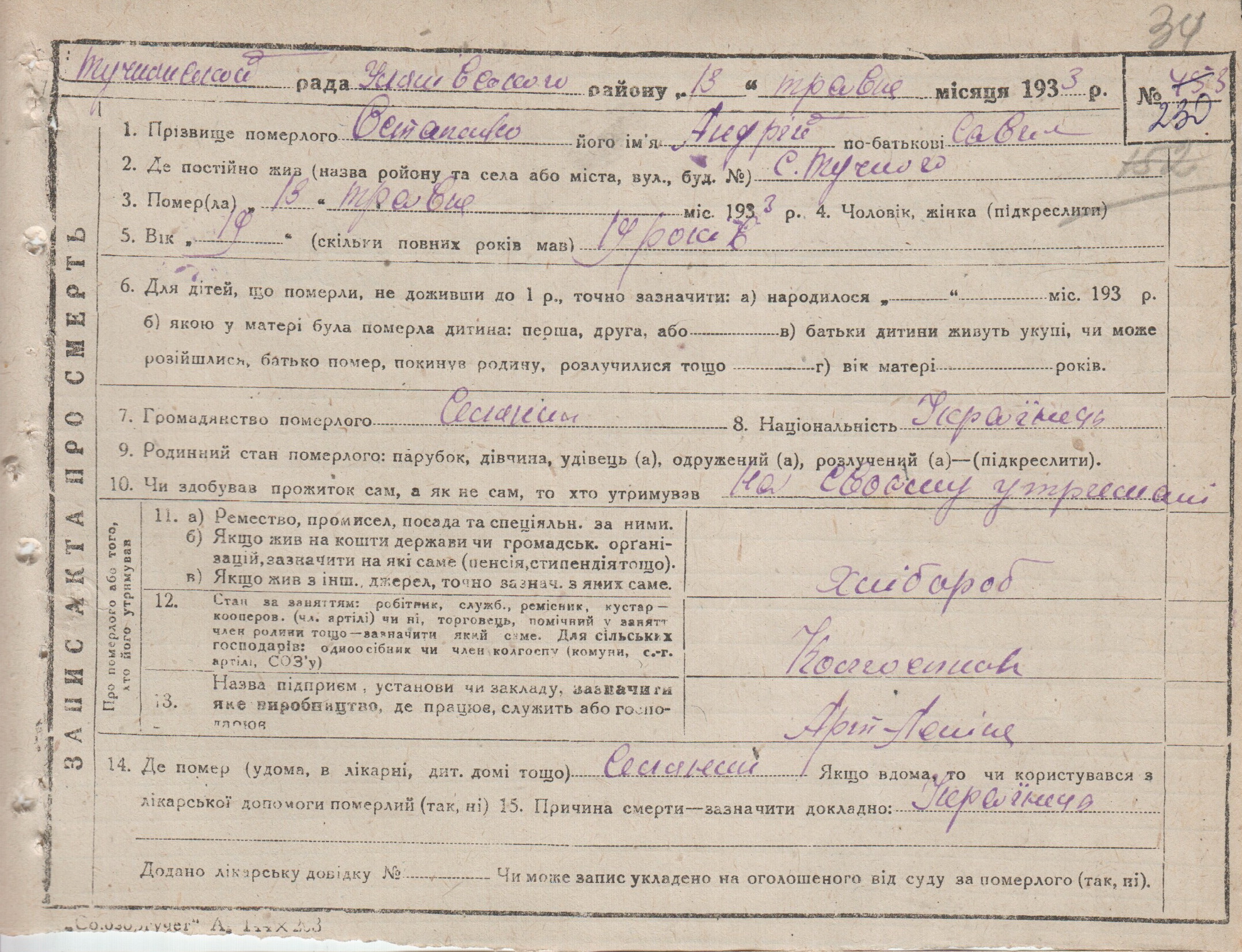
Дуже характерна канцелярська помилка (в графу “причина смерті”[4] вписано національність – Українець). Подальший аналіз статистики показує, що канцелярист був недалекий від істини.
Іншу групу висновків про смерть становлять медичні терміни, які, на думку фахівців-архівістів, ще мають пройти дослідження медпрацівниками з кількох причин. По-перше, необхідно чітко ідентифікувати діагнози, писані в ті часи медиками і не медиками, чорнилом і олівцем, каліграфічним почерком і незрозумілими скороченнями, а то й зовсім нерозбірливо. Значна частина записів про смерть – це документи зі згасаючим текстом, тому повне їх оцифровування для створення фонду використання документів про Голодомор виявилося своєчасним [5].
Далі слід відібрати медичні діагнози, тих хвороб, які виникають як наслідок тривалого голодування, ослаблення організму, харчового отруєння тощо.
Слід зазначити, що вищенаведені причини смерті і так часто фігурують в документах. Але треба знати і те, під яким пресом перебували медичні працівники в 1930-х роках. Тому значна частина смертей від голоду „прихована” під різними надуманими діагнозами. Отже, наступним кроком має бути порівняння причин смерті конкретних людей в конкретних населених пунктах, наведених за документами ДАСО, зі списками загиблих від голоду, зібраними робочими групами на місцях. Тут буде видно і масштаби фальсифікацій діагнозів, і, можливо, виникнуть нові імена, не обліковані в книгах РАЦС, або відсутні в них через те, що книги не збереглися.
Звичайно, серед документів ДАСО найбільшу увагу привертають діагнози смертей, які прямо вказують причину – голод. Таких можна виділити кілька груп:
– „від голоду”, „голод”, „голодування” „истощене организма на почве голода” найбільше зустрічаються в книгах РАЦС по Недригайлівському [6], Сумському[7], Конотопському[8], Путивльському[9], Білопільському[10], Роменському[11], Тростянецькому[12], Краснопільському[13], Глухівському[14] районах.
– „недоїдання”, „від схуднення”, „худання”, „упадок питания”, „порушення живлення”, „от истощенного питания”, „от пониженого питания”, „истощение вследствии недоедания”, „виснаження шлунку”, „отощалість”, „недостатнє харчування”, „виснаження організму на ґрунті недоїдання”, тобто комплекс причин, які пояснюють смерть людей через недостатність харчування, отже, знову ж через голод – найчастіше зустрічаються в книгах РАЦС Сумського[15], Шосткинського[16], Недригайлівського[17], Середино-Будського[18], Конотопського[19], Путивльського[20], Білопільського[21], Лебединського[22], Липово-Долинського[23], Тростянецького[24], Охтирського[25], Краснопільського[26] районів.
– Група діагнозів, які фіксують настання смерті людини через крайнє виснаження організму внаслідок голоду, досить строката за своїми різновидами: „від слабкості”, „від схуднення”, „виснаження”, „виснаження організму”, „знесилення організму”, „загальне виснаження”, „виснаження сил”. Досить часто, як різновид, зустрічається діагноз „старече виснаження”, причому в окремих випадках це стосується і дітей. Наприклад, по с. Улянівка теперішнього Білопільського району, цей діагноз було написано 8-річній дитині[27]. Саме з таких причин слід розглядати даний діагноз, як приховану форму смерті від голоду. До цієї групи входять також наступні види діагнозів: „худосочна слабість”, „на почве истощения” „отощалість”, „астенія”, „різке малокровіє”, та „загальна слабкість”, а також велика кількість пов`язаних з ними записів „серцева слабкість”, „серцева недостатність”, „серцева кволість”, „упадок серцевої діяльності”, „припинення серцевої діяльності”, або „міокардит завдяки недоїдання та упадка сил”[28], та інші, які вказують на смерть від виснаження внаслідок голоду і важких умов роботи в колгоспах. Ілюстрацією таких випадків є запис „Припинення сердечної діяльності. Смерть настигла раптом під час праці в полі”[29]. Вище перелічені записи про смерть зустрічаються в книгах РАЦС Великописарівського[30], Сумського[31], Середино-Будського[32], Глухівського[33], Недригайлівського[34], Шосткинського[35], Кролевецького[36], Путивльського[37], Конотопського[38], Білопільського[39], Роменського[40], Липово-Долинського[41], Тростянецького[42], Охтирського[43] районів, міст Суми[44] та Шостка[45]. Діагнози, які вказують на ті ж причини смерті, але з застосуванням медичних термінів, або, принаймні, його спробою, зустрічаються в книгах Краснопільського[46] і Лебединського[47] районів, наприклад: „біохім. істощеніє”, „кахексія”, тобто коли маса тіла нижча за 80% від нормальної. Так, по с. Славгород Краснопільського району діагноз „кахексія” становить більшість записів[48].
– Дуже велику групу записів становлять ті, які свідчать про харчові отруєння та смерть внаслідок вживання в їжу різних недоброякісних, сурогатних продуктів, або різкого збільшення споживання їжі після тривалого голодування. (Про такі випадки є безліч прикладів у виданих працях про Голодомор 1932-1933 років.) Це, насамперед, такі діагнози про смерть як: „дизентерія”, „розлад живлення”, „розлад травлення”, „запалення кишок”, „запалення кишечника”, „дифтерит”, „токсичний понос”, „кров`яний понос”, „інфекційний понос”, „от истощения поносом”, „неправильное кормление”, „аутоінтоксикація”, „кишкова інтоксикація”, „шлунково-кишкова інтоксикація”, „заворот кишок”, „поворот кишок”, „розстройство кишок і шлунку”, „розлад кишківника”, „розлад харчового тракту”, „запалення шлунку”, „від отруєння шлунку і кишок”, „отруєння зеленими фруктами”, „різачка”, „від засоренія кишок”, „запалення брюшини”. Є записи, які вказують одночасно на дві, або декілька причин смерті, наприклад, „расстройство пищеварения и упадок питания”. Наведені приклади діагнозів найчастіше зустрічаються в книгах РАЦС Лебединського[49], Краснопільського[50], Охтирського[51], Тростянецького[52], Липово-Долинського[53], Роменського[54], Білопільського[55], Путивльського[56], Конотопського[57], Глухівського[58], Середино-Будського[59], Кролевецького[60], Великописарівського[61], Сумського[62], Шосткинського[63], Недригайлівського[64] районів, а також міст Сум[65], Шостки[66], Конотопа[67]. Слід розуміти і те, що медичні працівники під тиском влади частіше вказували саме такі причини смертей, ніж розкривали їх справжній зміст.
– Останню з великих груп діагнозів про смерть внаслідок голоду становлять записи, в яких фігурують медичні терміни. І хоча, як було зауважено, попереду ще велика робота з їх опрацювання, уже зараз можна виділити ті з них, які безпомилково вказують на масову смертність людей від організованого російським комунізмом геноциду українського народу. Причому, в цих випадках вони, як правило, не пов`язані з харчуванням людини, а є, скоріше, наслідком крайнього виснаження, або фіксацією зовнішніх проявів голодної смерті. Серед цих записів найбільшу увагу привертають такі: „від сухот”, „туберкульоз”, „рахіт”, „дистрофія”. Окремі мають подвійний характер, як, наприклад, „от голода и воспаления легких”[68], що наштовхує на припущення про велику кількість фактів смерті від голоду, які криються під зовні „звичайними” діагнозами. Нарешті, найбільш масовим і шокуючим є пласт документів з такими записами про причину смерті: „набряк”, „голодний набряк”, „опухоль ног”, „від опуху”, „от голодного отека ног”, „безбілковий набряк”, або „безбелковый отек”, іноді скорочено – „ББО”. Зазначені терміни найчастіше зустрічаються в документах Білопільського[69], Буринського[70], Великописарівського[71], Путивльського[72], Конотопського[73], Глухівського[74], Середино-Будського[75], Кролевецького[76], Шосткинського[77], Недригайлівського[78], Сумського[79], Роменського[80], Липово-Долинського[81], Охтирського[82], Краснопільського[83], Лебединського районів[84], міст Охтирка[85] і Суми[86].
Говорячи про дослідження діагнозів смертей, треба взяти до уваги і їх кількісні характеристики. Попереду у дослідників Голодомору ще велика робота у цьому напрямі. Покищо можна зробити лише окремі підрахунки, але і вони уже говорять про величезні масштаби і наслідки організованого народовбивства. Наприклад, книга РАЦС по с. Недригайлів за 1933 рік дає такі цифри: з 574 актових записів про смерть 188, або 33 % мають діагноз „від голоду”, 167 записів, або 30 % – „виснаження” і 8 записів, або 1,4 % – „від недоїдання”. Тобто 64,4 % записів прямо говорять про знищення населення Недригайлова шляхом приречення на голодну смерть. У графі про національність кожного з них, стоїть „українець”, а за родом занять усі померлі, крім двох, – хлібороби[87].
Досить показовим є досліження людських втрат по м. Суми за 1932 р., здійснене архівістами Державного архіву Сумської області. Воно показує, що частка смертей серед українців становила 94,8 % (Див. схему):
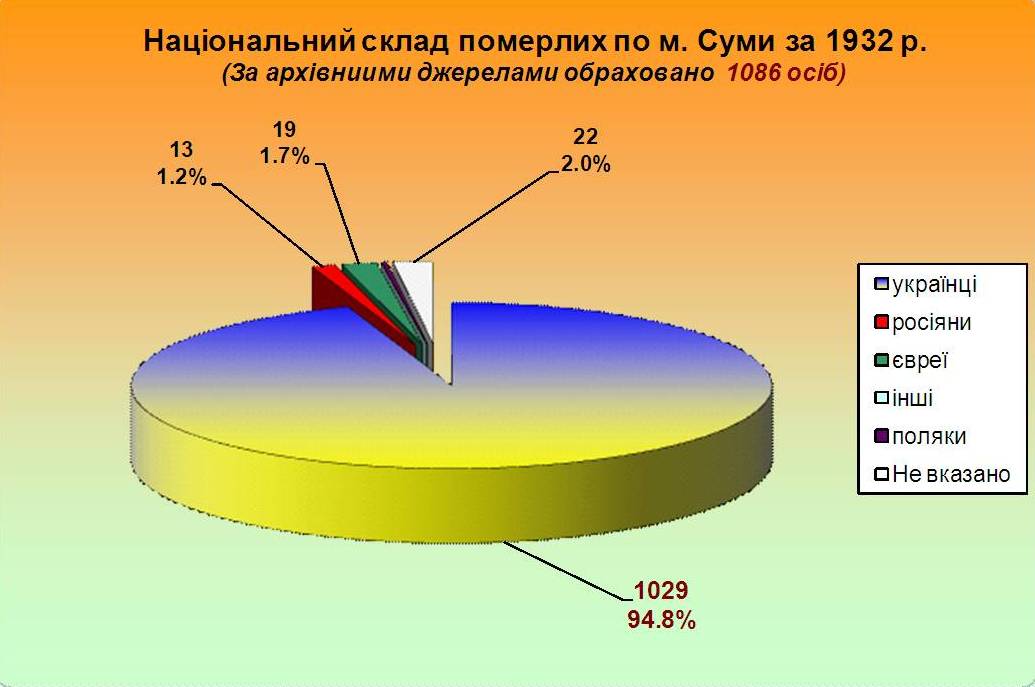 Підрахунок зроблено на підставі книг РАЦС по м. Суми [88]
І це лише через 4 роки після 1928 р., коли, за даними статистичного збірника “Довідник Сумської округи”. (1928 р. – Суми. – “Сумидрук”– 1929. – 371 с.) – українці складали 80,65 % населення міста!
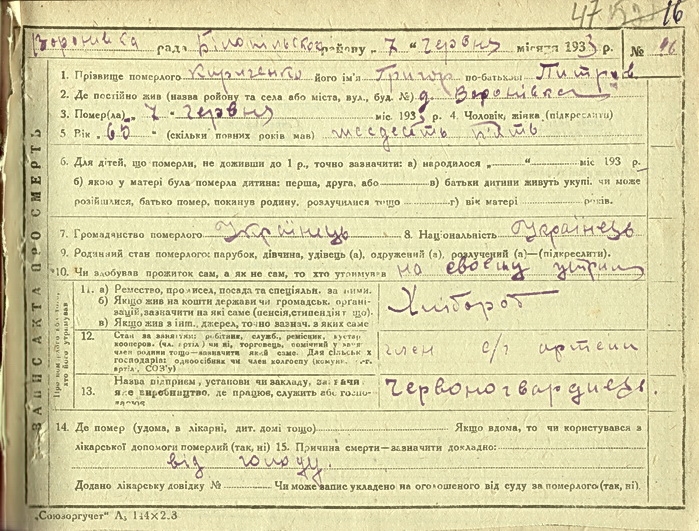
Подібні жахливі факти розкриває лише поверховий аналіз книг РАЦС інших районів. Так, з книги РАЦС за 1933 рік по с.с. Каліївка, Крупець, Лушники, Маківка, Миронівка, Ображіївка, Погребки, Свірж Шосткинського району приблизно половина діагнозів записана, як „невідомо від чого”, а у половини відсутній лікарський висновок[89]. Також з діагнозом „невідомо” фігурують села Білопільського району: Бобрик – практично вся книга, 176 записів про смерть[90], Верхосулка – вся книга, 192 записи[91], Нові Вирки – вся книга, 181 запис[92], Тучне – вся книга, 217 записів[93]. По селу Улянівка теперішнього Білопільського району за 1933 рік зі 161 запису про смерть в жодному випадку не вказано причини. Причому, перегляд прізвищ та дат підтверджує численні спогади очевидців геноциду про те, що люди вимирали цілими сім`ями[94]. Майже всі книги з таким самим діагнозом по селах Липово-Долинського району: Русанівці – всього 205 записів[95], Яганівці – 481, Лучці – 484, Рибальському – 135[96]. По селу Горобівці Білопільського району за 1933 рік (всього 224 акти про смерть), більшість записів з діагнозом „недоїдання”, або „невідомо”[97]. а за цей самий рік в іншій частині Білопільщини, в селах Шкуратівка і Нагірнівка зі 161 померлого половина також загинула від недоїдання[98]. Велика кількість загиблих від голоду помітна, коли ми проаналізуємо смерть від набрякової хвороби. За останній рік багато писалося про трагедію с. Піски Буринського району, де з померлих за 8 місяців 1933 року 1195 громадян понад 85 % було з діагнозом „безбілковий набряк”[99]. Подібна ситуація була і в інших населених пунктах теперішньої Сумщини. Наприклад, в Конотопі за 1933 рік із загальної кількості померлих – 133, одна третина померла з діагнозом „виснаження”, або „серцева слабкість”[100]. а в с Бочечки Конотопського району з 236 померлих у 1933 році майже половина загинула з діагнозами „запалення шлунку” та „набрякова хвороба”[101]. Діагноз „безбілковий набряк” фіксується у багатьох випадках по книгах РАЦС сіл Супрунівка і Біликівка Білопільського району (з 250 записів – майже вся книга)[102]. Сергіївка та Миколаївка-Тернівська (близько 70 записів смерті з діагнозом ББО)[103] та Глушець (104 записи)[104]. По місту Лебедин з діагнозом „ББО” тільки за період з 13 по 30 липня 1933 року померло 135 людей з поміткою замість прізвища „невідомий”[105]. Можливо, це були ті, хто приходив з інших місцевостей у пошуках їжі.
Окремої розмови при досліджені Голодомору 1932-1933 років заслуговує ставлення влади до фіксації смертей від голоду. Іноді, досить лише поглянути на певні спроби пробити стіну мовчання і розповісти бодай частину правди про страшну трагедію, яка розгорталася поруч оптимістичних повідомлень про ударні темпи хлібозаготівель, щоб зрозуміти історичну приреченість системи. Системи, яка не тільки нищила голодом давній і працьовитий народ на найродючіших у світі чорноземах, а й топталася по живій пам`яті мільйонів людей, десятки років заперечуючи правду. Свідчення про смерть людей – вони, як дзеркало, в якому видно і людську трагедію і її режисерів. Шокуючі діагнози про смерть людей від рук своїх рідних і близьких, збожеволілих від голоду, як: „порубано сокирою” – 5 випадків по с. Червоне Сумського району[106], або „зарізана матір`ю”(вік 2 роки) по с. Підлипне Конотопського району[107], чи „зарубав брат”[108] не вносять дисонансу у загальну картину замовчування правди. Під страхом репресій, а можливо, і за прямою вказівкою з`являються записи: „нормальна смерть”[109], „прожила свій вік” (жінці було 55 років)[110]. „від плохого утримання” (77 записів)[111]. або вкрай цинічне „естественная изношенность”[112]. А по с. Піщаному Сумського району за 1932 рік ми бачимо 28 записів „був хворий довгий час”, „була хвора і стара”[113]. Інакше, як виявом „батьківської турботи” правлячої партії про людей, це не назвеш.
Таким чином, наявні книги РАЦС містять значну кількість інформації про смерть громадян в період Голодомору 1932-1933 років. Саме вони стають тією основною документальною базою, на якій створюються і будуть створюватись загальноукраїнські та регіональні списки загиблих. Звичайно, ми ніколи не будемо знати повної кількості померлих від голоду, адже страх перед репресіями сприяв тому, що в книги РАЦС потрапили далеко не всі, та й діагнози про смерть не в повній мірі відобразили масштаби трагедії. Крім того, відсутність книг РАЦС по багатьох населених пунктах (через їх знищення комуністичною владою, або вивезення), як і порівняно невелика кількість людей, які пам`ятають Голодомор значно ускладнюють пошук. Частково зарадити цій проблемі може порівняльний аналіз кількості померлих за книгами РАЦС протягом 1930 – 1934 років. В цьому випадку ми зможемо побачити динаміку смертності по окремих населених пунктах. Так, скажімо, по м. Суми померло: в 1930 р. – 863, 1931 р. – 1018, 1932 р. – 1314, 1933 р. – 3908 осіб. (Див. графік)
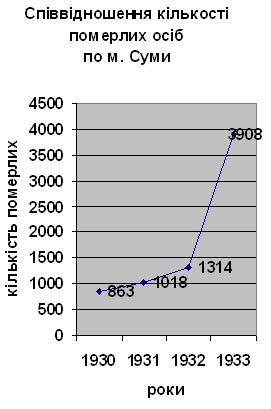
Опрацювання книг РАЦС за 1934 рік дає ще одну перевагу в дослідженні Голодомору, адже об`єктом уваги науковців і суспільства в цілому стануть люди, які також померли внаслідок створених комуністичною системою ненормальних умов існування протягом 1933 року.
Уже сьогодні стає зрозумілим, що смертність в період Голодомору в сільській місцевості перевищувала людські втрати в роки Другої Світової війни. Зрештою, життя кожної людини є унікальним, а смерть – планетарною трагедією, незважаючи на те, від чого вона настала. Тому, попри всі об`єктивні та суб`єктивні труднощі, дослідниками має бути зроблено все для збереження пам`яті про кожного, хто став жертвою неоголошеної війни проти українського народу.
Восени цього року вся електронна база даних по книгах реєстрації смертей у Сумській області в 1932-1933 роках буде оприлюднена в мережі Інтернет одразу на двох ресурсах: Електронному архіві визвольного руху www.avr.org.ua та Сумському історичному порталі: www.history.sumynews.com
Це значно розширить коло науковців-істориків, які вивчають геноцид українського народу. Для родичів загиблих такий ресурс буде засобом пошуку і повернення пам`яті про близьких людей.
Використані джерела:
1. Див. статтю Лемкіна “Радянський геноцид в Україні”, надруковану в 1953 р. Повний текст в онлайні тут:
http://www.uccla.ca/SOVIET_GENOCIDE_IN_THE_UKRAINE.pdf. В українському перекладі див.: Рафаель Лемкін. Радянський геноцид в Україні. К., 2009. – “Майстерня книги”. – С. 31-32.
2. Калиник О. Що несе з собою комунізм? Документи про російсько-комуністичний терор в Україні. – Мюнхен-Торонто. – 1953. – 142 с.
3. Див.: Голодомори в Україні: Одеська область (1921-1923, 1932-1933, 1946-1947), дослідження, спогади, документи. ( кол. авт. та упоряд). – Одеса: Астропринт, 2007 – 460 с.
4. ДАСО. Ф.Р. 7720, оп. 1, спр. 458, арк. 34.
5. Всього було оцифровано 266 книг РАЦС, 56 510 актових записів про смерть з усіх районів області, крім Ямпільського, книги якого на зберігання до ДАСО не надходили.
6. ДАСО. ф.Р. 7720, оп.10.
7. ДАСО. ф.Р. 7720, оп.15.
8. ДАСО. ф.Р. 7720, оп.5, 21.
9. ДАСО. ф.Р. 7720, оп.12.
10. ДАСО. ф.Р. 7720, оп.1.
11. ДАСО. ф.Р. 7720, оп.13.
12. ДАСО. ф.Р. 7720, оп.16.
13. ДАСО. ф.Р. 7720, оп.6.
14. ДАСО. ф.Р. 7720, оп.4, 20.
15. ДАСО. ф.Р. 7720, оп.15.
16. ДАСО. ф.Р. 7720, оп.17.
17. ДАСО. ф.Р. 7720, оп.10.
18. ДАСО. ф.Р. 7720, оп.14.
19. ДАСО. ф.Р. 7720, оп.5, 21.
20. ДАСО. ф.Р. 7720, оп.12.
21. ДАСО. ф.Р. 7720, оп.1.
22. ДАСО. ф.Р. 7720, оп.8.
23. ДАСО. ф.Р. 7720, оп.9.
24. ДАСО. ф.Р. 7720, оп.16.
25. ДАСО. ф.Р. 7720, оп.11.
26. ДАСО. ф.Р. 7720, оп.6.
27. ДАСО. ф.Р. 7720, оп.1, спр. 422, арк. 64.
28. ДАСО. ф.Р. 7720, оп.8, спр.291, арк.71-73, 76, 80.
29. ДАСО. ф.Р. 7720, оп.4, спр.77, арк.38.
30. ДАСО. ф.Р. 7720, оп.3.
31. ДАСО. ф.Р. 7720, оп.15.
32. ДАСО. ф.Р. 7720, оп.14.
33. ДАСО. ф.Р. 7720, оп.4, 20.
34. ДАСО. ф.Р. 7720, оп.10.
35. ДАСО. ф.Р. 7720, оп.17.
36. ДАСО. ф.Р. 7720, оп.7.
37. ДАСО. ф.Р. 7720, оп.12.
38. ДАСО. ф.Р. 7720, оп.5, 21.
39. ДАСО. ф.Р. 7720, оп.1.
40. ДАСО. ф.Р. 7720, оп.13.
41. ДАСО. ф.Р. 7720, оп.9.
42. ДАСО. ф.Р. 7720, оп.16.
43. ДАСО. ф.Р. 7720, оп.11.
44. ДАСО. ф.Р. 7720, оп.24.
45. ДАСО. ф.Р. 7720, оп.26.
46. ДАСО. ф.Р. 7720, оп.6.
47. ДАСО. ф.Р. 7720, оп.8.
48. ДАСО.ф.Р. 7720, оп.6, спр.338.
49. ДАСО. ф.Р. 7720, оп.8.
50. ДАСО. ф.Р. 7720, оп.6.
51. ДАСО. ф.Р. 7720, оп.11.
52. ДАСО. ф.Р. 7720, оп.16.
53. ДАСО. ф.Р. 7720, оп.9.
54. ДАСО. ф.Р. 7720, оп.13.
55. ДАСО. ф.Р. 7720, оп.1.
56. ДАСО. ф.Р. 7720, оп.12.
57. ДАСО. ф.Р. 7720, оп.5, 21.
58. ДАСО. ф.Р. 7720, оп.4, 20.
59. ДАСО. ф.Р. 7720, оп.14.
60. ДАСО. ф.Р. 7720, оп.7.
61. ДАСО. ф.Р. 7720, оп.3.
62. ДАСО. ф.Р. 7720, оп.15.
63. ДАСО. ф.Р. 7720, оп.17.
64. ДАСО. ф.Р. 7720, оп.10.
65. ДАСО. ф.Р. 7720, оп.24.
66. ДАСО. ф.Р. 7720, оп.26.
67. ДАСО. ф.Р. 7720, оп.21.
68. ДАСО. Ф.Р. 7720, оп.11, спр.255.
69. ДАСО. ф.Р. 7720, оп.1.
70. ДАСО. ф.Р. 7720, оп.2.
71. ДАСО. ф.Р. 7720, оп.3.
72. ДАСО. ф.Р. 7720, оп.12.
73. ДАСО. ф.Р. 7720, оп.5, 21.
74. ДАСО. ф.Р. 7720, оп.4, 20.
75. ДАСО. ф.Р. 7720, оп.14.
76. ДАСО. ф.Р. 7720, оп.7.
77. ДАСО. ф.Р. 7720, оп.17.
78. ДАСО. ф.Р. 7720, оп.10.
79. ДАСО. ф.Р. 7720, оп.15.
80. ДАСО. ф.Р. 7720, оп.13.
81. ДАСО. ф.Р. 7720, оп.9.
82. ДАСО. ф.Р. 7720, оп.11.
83. ДАСО. ф.Р. 7720, оп.6.
84. ДАСО. ф.Р. 7720, оп.8.
85. ДАСО. ф.Р. 7720, оп.23.
86. ДАСО. ф.Р. 7720, оп.24.
87. ДАСО. ф.Р. 7720, оп.10, спр.261.
88. ДАСО. Ф.Р. 7720, оп. 24, спр. 159-164; 180-196
89. ДАСО. ф.Р. 7720, оп.17, спр.190.
90. ДАСО. ф.Р. 7720, оп.1, спр.435.
91. ДАСО. ф.Р. 7720, оп.1, спр.439.
92. ДАСО. ф.Р. 7720, оп.1, спр.451.
93. ДАСО. ф.Р. 7720, оп.1, спр.458.
94. ДАСО.ф.Р. 7720, оп.1, спр.462.
95. ДАСО. ф.Р. 7720, оп.9, спр.132.
96. ДАСО. ф.Р. 7720, оп.9, спр.124, 125, 126, 127, 131, 271.
97. ДАСО. ф.Р. 7720, оп.1, спр.445.
98. ДАСО. ф.Р. 7720, оп.1, спр.463.
99. Федорина А. Три книги 1933 року. [Електронний ресурс] Режим доступу: http://www.pravda.com.uawww.umoloda.kiev.ua/regions/62/171/0/32579/
100. ДАСО. ф.Р. 7720, оп.21, спр.129.
101. ДАСО. ф.Р. 7720, оп.5, спр.330.
102. ДАСО. ф.Р. 7720, оп.1, спр.454.
103. ДАСО. ф.Р. 7720, оп.1, спр.453.
104. ДАСО. ф.Р. 7720, оп.1, спр.464.
105. ДАСО. ф.Р. 7720, оп.22, спр.66, арк.35-105.
106. ДАСО. ф.Р. 7720, оп.15, спр.397, арк.14-18.
107. ДАСО. ф.Р. 7720, оп.21, спр.115, арк.79.
108. ДАСО ф.Р. 7720, оп.11, спр.265, арк. 145.
109. ДАСО. ф.Р. 7720, оп.16, спр.278, арк.114.
110. ДАСО. ф.Р. 7720, оп.10, спр.255, арк.29.
111. ДАСО ф.Р. 7720, оп.11, спр.265, арк. 124-136, 134-135, 137-142, 144-150, 152-154, 157-174, 176-177, 180, 182-185.
112. ДАСО. ф.Р. 7720, оп.7, спр.71, арк.82, 91.
113. ДАСО. ф.Р. 7720, оп.24, спр.161.
Diagnoses of Death during the Holodomor of 1932–33 as a Source for Creating a Victim Database
“As long as
long as its people continue to think of themselves as Ukrainians and to seek
independence, so long
The artificially-engineered famine, known as the Holodomor, is the focus of a large number of scholarly publications and media reports because for the first time in the history of modern Ukrainian statehood this topic has begun to attract the attention of both the Ukrainian public and the international community. A significant factor in this surge of interest in the Holodomor is the fact that Ukrainian society is continuing to come to grips with these tragic and instructive pages from the history of the Ukrainian nation. For millions of Ukrainians, research on the Holodomor- genocide continues to be a factor of self-identification.
It is important to note that some studies of the Holodomor do not cite any primary sources, above all, archival documents. While collections of directive documents and documented memoirs, which shed a general light on the genocide of the Ukrainian people, have already been published, it is to be expected that hardly any personal data exist on Ukrainians who starved to death, even though the creation of such information is constantly emphasized in nationwide and local Ukrainian research programs and commemorative measures.
This is precisely why, in the absence of a documentary base, there is no body of historical work on this topic. Some notable exceptions include Oleksa Kalynyk’s book What Does Communism Entail?[2] as well as a small number of publications that have appeared in recent years.[3] This is explained by the fact that until recently the records of all branches of the Civil Registry Office (RATsS; Rus. ZAGS) for 1932–33—the main documentary sources on this set of questions—were stored in sub-departments of Ukraine’s Ministry of Justice. Today they are part of the permanent holdings of oblast-based state archives. As of autumn 2007, 715 documents were transferred to the State Archive of Sumy Oblast (DASO). Keeping in mind that approximately one-third of them consist of documents recording the deaths of people during the Holodomor, in this article we will analyze diagnoses of death in 1932–33 and examine the prospects for compiling a database of victims of the genocide with the aid of data collected from several raions (districts) located in
Analyzing diagnoses of death allows Holodomor researchers not only to study quantitative features, but also affords them the opportunity to examine the problem from various angles. For example, if we look at 182 diagnoses studied thus far, we can see the scale on which the history of the Holodomor was being falsified when the genocide was already in full swing. The presence in a single registry volume of such causes of death as “unknown” and “from sickness”, which were issued for dozens and hundreds of victims, as well as the complete absence of cause of death demonstrate that the Soviet communist government was deliberately concealing the truth about the famine and that the Soviet leaders were fully aware of their criminal actions. Therefore, the attempts of contemporary apologists of Bolshevism to attribute the human losses to drought, “wrecking by kulak elements,” or the “hostile capitalist surroundings” are completely groundless.
CAPTION: This document features a typical bureaucratic error: the deceased’s nationality, Ukrainian, is also listed in the section entitled “Cause of Death.”[4] Statistical analysis reveals that civil registry clerks were not far off the mark.
Another group of diagnoses of death consists of medical terms that, in the view of archival specialists, must still be researched by medical personnel—for a number of reasons. First of all, it is crucial to identify diagnoses that were recorded during this period by both physicians and non-medical personnel in ink and pencil, calligraphic script, and incomprehensible abbreviations, as well as those that are completely indecipherable. A significant proportion of death certificates is comprised of documents with faded text; therefore their full digitization for the purpose of creating a collection of Holodomor documents is a timely project.[5] Next, it is necessary to select medical diagnoses of illnesses that ensued as a consequence of prolonged starvation, weakening of the human organism, food poisoning, and the like.
It is important to note that the above-mentioned causes of death are frequently present in documents. That said, one must also be aware of the pressure to which medical personnel were subjected in the 1930s. Thus, a significant number of deaths from starvation is “hidden” in various fabricated diagnoses. This means that the next step should be to compare the causes of death of concrete individuals in specific population centers, as cited in DASO documents, along with lists of those who died of starvation, which have been compiled by local working groups. Such data will reveal the scale of falsified diagnoses of death, and new names may be uncovered, which were never registered by the Civil Registry Office or are missing because the registration books did not survive.
The documents stored at DASO reveal that the most compelling diagnoses of death are those that indicate starvation as the cause of death. There are several groups of these diagnoses:
- Diagnoses, including “due to starvation,” “starvation,” “starving, “emaciation due to starvation,” are most frequently encountered in Civil Registry Office records for Nedryhailiv,[6] Sumy,[7] Konotop,[8] Putyvl,[9] Bilopillia,[10] Romny,[11] Trostianets,[12] Krasnopillia,[13] and Hlukhiv raions.[14]
- Diagnoses indicating the deaths of people from food insufficiency include “malnutrition,” “from loss of weight,” “weight loss,” “nutrition decline,” “disturbance of nutrition,” “because of depleted nutrition,” “from reduced sustenance,” “emaciation as a result of malnutrition,” “emaciation of the stomach,” “emaciation,” “inadequate sustenance,” “emaciation of the organism due to malnutrition.” Therefore, these causes of death due to starvation are most often encountered in the Civil Registry Office records for Sumy,[15] Shostka,[16] Nedryhailiv,[17] Seredyna-Buda,[18] Konotop,[19] Putyvl,[20] Bilopillia,[21] Lebedyn,[22] Lypova Dolyna,[23] Trostianets,[24] Okhtyrka,[25] and Krasnopillia raions.[26]
- There is a group of varied diagnoses recording people’s deaths from extreme emaciation and exhaustion as a result of starvation: “from weakness,” “because of weight loss,” “emaciation,” “exhaustion of the organism,” “weakening of the organism,” “general exhaustion,” “depletion of energy.” Another frequently encountered diagnosis is “geriatric emaciation,” a term that in some cases was also applied to children. For example, in the
Offices in the districts of Velyka Pysarivka,[30] Sumy,[31] Seredyna-Buda,[32] Hlukhiv,[33] Nedryhailiv, [34] Shostka,[35] Krolevets,[36] Putyvl,[37] Konotop,[38] Bilopillia,[39] Romny,[40] Lypova Dolyna,[41] Trostianets,[42] Okhtyrka,[43] as well as in the cities of Sumy[44] and Shostka.[45] Diagnoses indicating these causes of death but which also contain medical terms or at least reflect an attempt to apply such terminology appear in the record books for Krasnopillia[46] and Lebedyn[47] raions, for example: “biochem[ical] depletion,” “cachexia,” that is, when the body mass is 80 percent lower than normal. Thus, the diagnosis of “cachexia” comprises the majority of death entries recorded for the
- A large group of death entries is comprised of those that indicate food poisoning or death resulting from the consumption of various kinds of poor-quality, surrogate food products or an increase in food consumption after protracted starvation. (There are countless examples of such cases in the literature on the Holodomor of 1932–1933.) They include, above all, the following diagnoses of death: “dysentery,” “nutrition disorder,” “digestive disorder,” “inflammation of the intestines,” “inflammation of the bowel,” “diphtheria,” “toxic diarrhea,” “bloody diarrhea,” “infectious diarrhea,” “due to emaciation resulting from diarrhea,” “incorrect nutrition,” “auto-intoxication,” “intestinal intoxication,” “gastrointestinal intoxication,” “volvulus” [bowel obstruction of a loop of bowel—Trans.], “bowel obstruction,” “gastrointestinal disorder,” “intestinal disorder,” “disorder of the alimentary canal,” “inflammation of the bowel,” “due to poisoning of the stomach and bowels,” “poisoning by green [i.e., unripe] fruits,” “rizachka” [stabbing pain in the abdomen—Trans.], “due to intestinal obstruction,” and “inflammation of the peritoneum.” There are also death entries that indicate two or more causes of death, for example: “digestive disorder and decline of nourishment.” The above-mentioned diagnoses are encountered most frequently in the record books of Civil Registry Offices in Lebedyn,[49] Krasnopillia,[50] Okhtyrka,[51] Trostianets,[52] Lypova Dolyna,[53] Romny,[54] Bilopillia,[55] Putyvl,[56] Konotop,[57] Hlukhiv,[58] Seredyna-Buda,[59] Krolevets,[60] Velyka Pysarivka,[61] Sumy,[62] Shostka,[63] and Nedryhailiv raions,[64] as well as in the cities of Sumy,[65] Shostka,[66]
and Konotop.[67] It must also be kept in mind that medical personnel, pressured by the authorities, more often indicated such causes of death instead of revealing their true nature.
- The last large group of diagnoses of death as a result of starvation is comprised of death entries featuring medical terms. As mentioned earlier, even though there is still much work to be done on these documents, even now it is possible to single out those that unmistakably indicate the mass mortality of people who perished during the Holodomor. In these cases they are not connected as a rule with a person’s nutrition but, rather, are a result of extreme emaciation or external manifestations of death from starvation. The most distinctive ones are: “due to tuberculosis,” “tuberculosis,” “rickets,” and “dystrophy.” Some diagnoses have a dual nature, for example, “from starvation and lung inflammation,”[68] which leads to the supposition that a large number of deaths caused by starvation are concealed behind “ordinary” diagnoses. Finally, by far the largest and most shocking is a group of documents that contain notes about the following causes of death: “edema,” “skull edema,” “swollen legs,” “from edema,” “from starvation edema of the legs,” “protein deficiency swelling,” or “protein deficiency edema,” sometimes indicated by the Russian abbreviation BBO (bezbelkovyi nabriak). These terms appear most often in documents produced in Bilopillia,[69] Buryn,[70] Velyka Pysarivka,[71] Putyvl,[72] Konotop,[73] Hlukhiv,[74] Seredyna-Buda,[75] Krolevets,[76] Shostka,[77] Nedryhailiv,[78]
With regard to research on diagnoses of death, their quantitative characteristics must also be considered. In this regard, much work lies ahead of Holodomor researchers. At present, it is only possible to arrive at individual estimates, but even they point to the immense scale and consequences of this deliberately organized murder of Ukrainians. For example, the Civil Registry Office’s record book for the village of Nedryhailiv contains the following figures for 1933: out of 574 death entries, 188 (33 percent), feature the diagnosis “due to starvation”; 167 death entries (30 percent), state “emaciation”; and 8 death entries (1.4 percent), state “because of malnutrition.” In other words, 64.4 percent of the death entries directly attest to the destruction of Nedryhailiv’s population by starvation. The column pertaining to the nationality of each victim contains the word “Ukrainian,” and all but two were peasants by occupation.[87]
The research completed by the archivists at the State Archive of Sumy Oblast on the number of deaths recorded in the city of
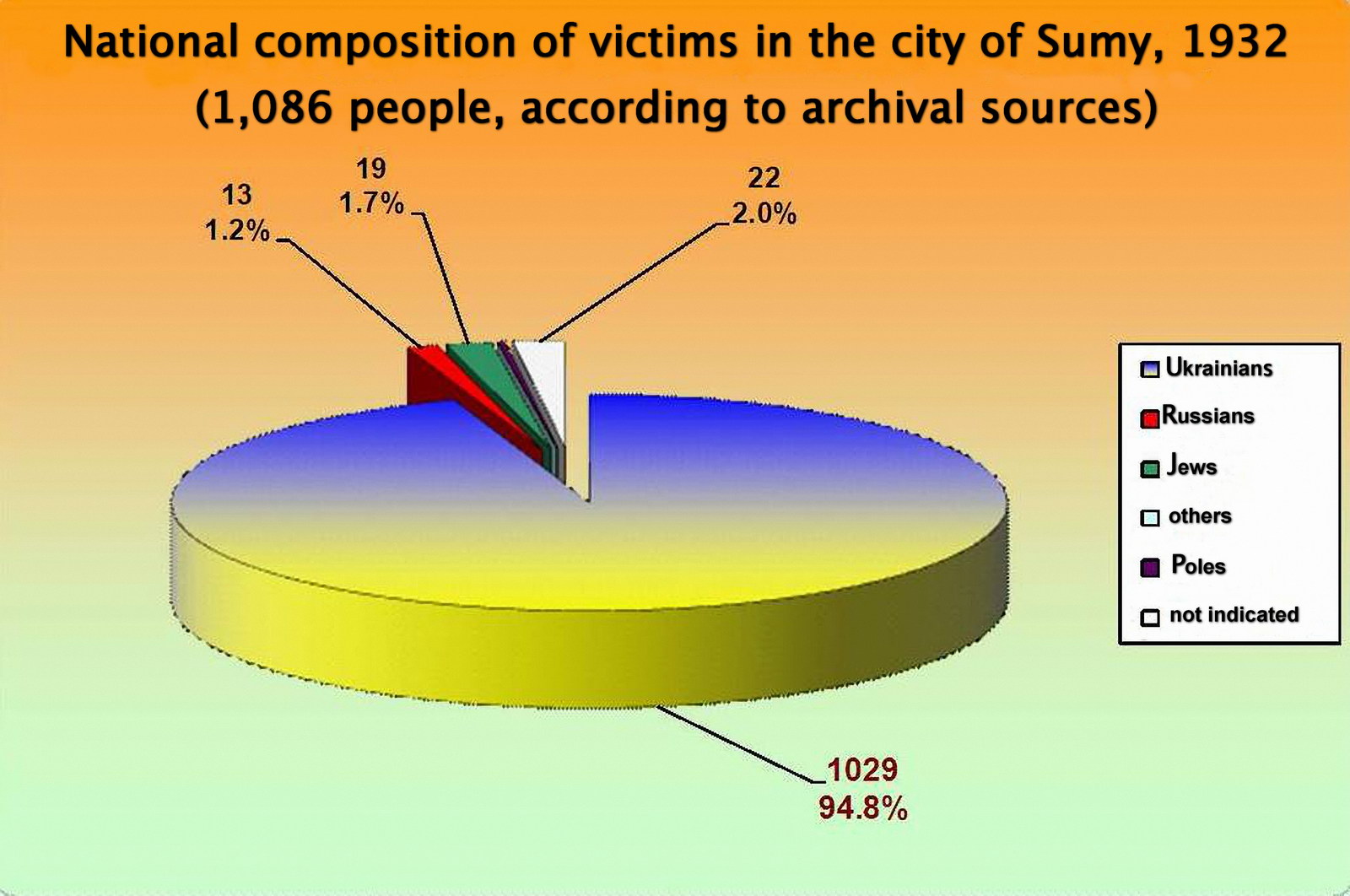
Estimate based on the Civil Registry Office (RATsS) books for the city of
According to the figures cited in the Dovidnyk Sums′koï okruhy (
Even a superficial examination of civil registration records from other raions reveals similar horrifying facts. For example, the 1933 the registration book for the villages of Kaliivka, Krupets, Lushnyky, Makivka, Myronivka, Obrazhiivka, Pohrebky, and Svirzh (Shostka raion) reveals that approximately 50 percent of all the death entries state “cause unknown,” while the other half are missing a doctor’s diagnosis.[89] The diagnosis “unknown” also appears in death entries recorded for several villages in Bilopillia raion: 176 death entries for Bobryk (practically the entire book)[90]; Verkhosulka—192 death entries (the entire book)[91]; Novi Vyrky—181 death entries (the entire book)[92]; and Tuchne—217 death entries (the entire book).[93] In the
The Soviet authorities’ attitude to the issue of recording deaths due to starvation during the Holodomor of 1932–33 merits special attention. At times, it suffices to glance at some sporadic attempts to break through the wall of silence and recount at least some of the truth about the horrific tragedy that was unfolding in Ukraine at the very time that the Soviet leaders were issuing optimistic reports about the accelerated pace of the state grain procurements. Accounts about the deaths of these hard-working people, who lived on the most fertile soil in the world, are like a mirror that also reflects the human tragedy of the perpetrators.
There are also many shocking diagnoses of death of people who perished at the hands of their loved ones, driven insane by starvation: these include “cut into pieces with an ax” (five cases in the village of Chervone, Sumy raion,[106]), “stabbed to death by the mother” (the female victim was two years old) in the village of Pidlypne, Konotop raion,[107] and “axed to death by the brother.”[108] These causes of death are part of the general picture of the genocide, the truth of which was suppressed for decades. Fearing repression or acting on direct orders, registrars at Civil Registry Offices began recording the following causes of death: “normal [i.e., natural] death,”[109] “[she] lived out her life” (the woman was 55 years old),[110] “as a result of poor maintenance” (77 death entries),[111] or the utterly cynical death entry “naturally worn out.”[112] Among the causes of death recorded in 1932 for the
Thus, the record books of Civil Registry Offices contain a wealth of information about Ukrainian citizens who perished during the Holodomor of 1932–33. They are becoming the fundamental documentary base on which nationwide and regional lists of victims will be created for a long time to come. Of course, we will never be able to establish the true number of famine victims because the pervasive fear of repression led to the circumstance that far from all deaths were registered. Moreover, diagnoses of death do not fully reflect the scale of this horrific human tragedy.
The search for victims is also complicated by the absence of vital statistics books in many populated areas (they were destroyed or spirited away by the Soviet government), as well as by the dwindling number of living eyewitnesses of the Holodomor. This problem can be partially remedied by a comparative analysis of the number of victims listed in civil registration books for the years 1930–34, which reveal mortality dynamics in individual populated areas. For example, the table below shows that in the city of
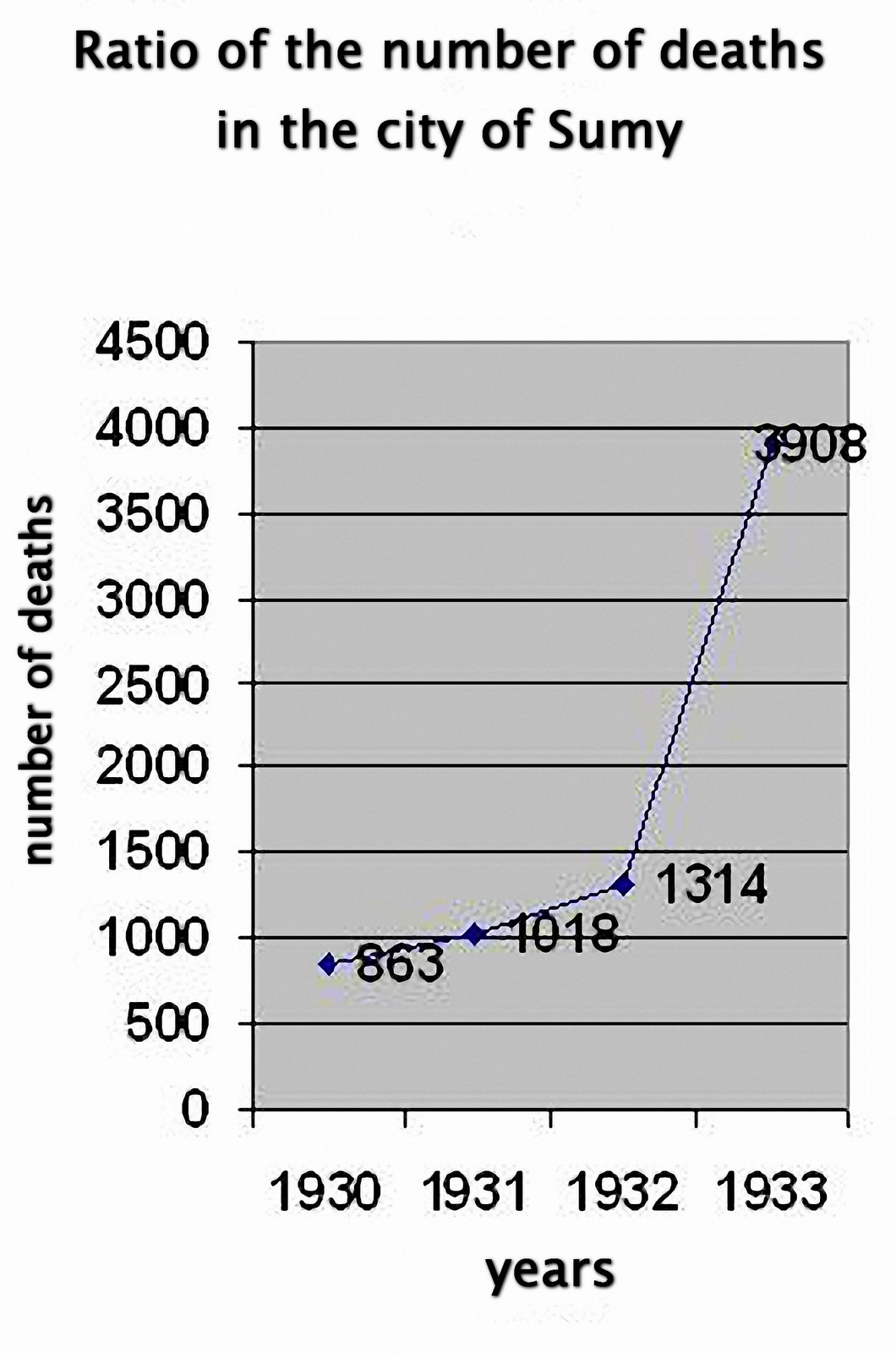
The study of vital statistics data books for 1934, the first year after the end of the Ukrainian famine-genocide, offers another distinct advantage for Holodomor research, as the attention of both scholars and members of the public will inevitably be focused on people who perished that year as a result of the abnormal living conditions that the Soviet communist leaders engineered in 1933.
It is already becoming clear that the mortality rate in
In the fall of 2013 the entire electronic database of the 1932–1933 death registry books for
Hennadiy Ivanushchenko
Translated from the Ukrainian by Marta D. Olynyk
Do not cite, publish or distribute without the author’s permission.
[1] See Lemkin’s essay, “Soviet Genocide in the
[2] Oleksa Kalynyk, Shcho nese z soboiu komunizm? Dokumenty pro rosiis′ko-komunistychnyi teror v Ukraïni (Munich; Toronto, 1953).
[3] See, e.g., Holodomory v Ukraïni: Odes′ka oblast′ (1921–1923, 1932–1933, 1946–1947), doslidzhennia, spohady, dokumenty (Odesa: Astroprynt, 2007).
[5] To date, the following materials have been digitized: 266 record books of the Civil Registry Office (RATsS) and 56,510 death entries from every district in
[99] A. Fedoryna, Try knyhy 1933 roku, located at: http://www.pravda.com.uawww.umoloda.kiev.ua/regions/62/171/0/32579/.